How Language Impacts Ecommerce Conversion Rates
Poor localization, bad translations, and language mismatches quietly reduce ecommerce conversions. Learn how AI translation fixes global selling friction.

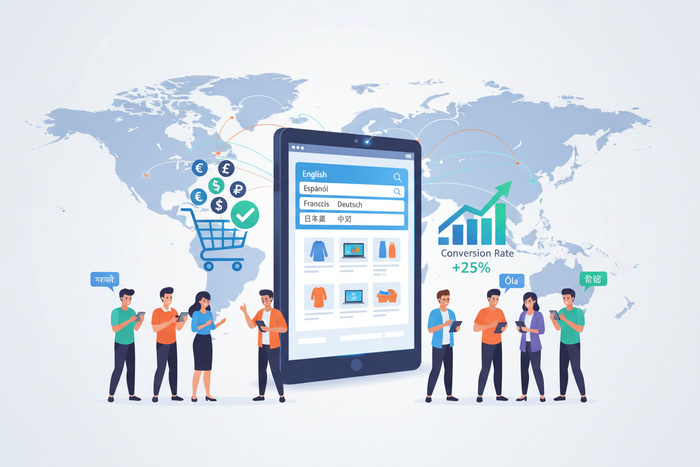
Many Shopify stores struggle to grow internationally not because their products lack demand, but because their localization strategy quietly fails. Shoppers arrive from different countries, yet the store feels foreign, confusing, or untrustworthy within seconds.

Why Shopify Stores Fail at Global Expansion
Global ecommerce growth is no longer optional. International traffic is accessible, affordable, and often high-intent. Yet many Shopify stores fail to convert that traffic because localization is treated as an afterthought.
Instead of creating a native shopping experience, stores rely on partial translations, mismatched currencies, and assumptions about customer behavior. The result is immediate friction.
When shoppers cannot fully understand product details, policies, or checkout steps, they hesitate. That hesitation turns into abandonment.
The Hidden Cost of Poor Auto-Translation
Automatic translation is often the first step merchants take when expanding globally. Unfortunately, it is also where many problems begin.
Basic machine translation frequently misses context, tone, and intent. Product descriptions sound robotic. Marketing messages lose persuasion. Brand voice disappears.
In ecommerce, language is not informational only. It is emotional. Poor translation signals low effort and low credibility.
Shoppers may understand the words, but they do not trust the experience.
Common translation issues that reduce trust
- Literal translations that ignore local phrasing and buying language.
- Awkward sentence structures that feel unnatural.
- Inconsistent terminology across product pages and policies.
- Checkout messages left untranslated.
Each of these errors creates small doubts. Combined, they significantly reduce conversion rates.
Why Cultural Mismatch Breaks Conversion
Localization goes beyond words. Cultural expectations influence how shoppers interpret visuals, tone, and structure.
Colors, imagery, humor, and even layout density carry meaning. What feels premium in one market may feel cheap or confusing in another.
Many Shopify stores reuse the same creative assets globally. This often leads to cultural disconnect.
Examples of cultural friction
- Using humor that does not translate or feels inappropriate.
- Showing imagery that does not reflect local lifestyles.
- Ignoring local shopping holidays and seasonal timing.
- Maintaining a brand tone that feels too aggressive or too passive for the market.
When cultural alignment is missing, shoppers subconsciously feel that the store is not built for them.
Technical Localization Mistakes That Kill Sales
Even when language looks acceptable, technical gaps often remain.
Many Shopify stores only translate visible content while ignoring structural and functional elements that influence trust.
Critical technical mistakes
- Prices displayed in foreign currencies.
- Missing local payment methods.
- Date, address, and measurement formats not localized.
- Tax, shipping, and return policies written for another region.
These issues are especially damaging at checkout, where clarity is essential.
Customers may understand the product but abandon the purchase because the final steps feel risky.
Why Multilingual SEO Is Often Ignored
Translation alone does not guarantee visibility.
Many stores translate content word-for-word without researching how customers search in each market. Keywords that work in English rarely perform the same when translated literally.
This leads to poor organic performance, even in markets with strong demand.
Common multilingual SEO mistakes
- Using translated keywords instead of local search intent.
- Duplicating content across languages without optimization.
- Ignoring local category naming conventions.

Without proper multilingual SEO, global traffic remains dependent on paid acquisition.
Localization Is Not a One-Time Task
Another major reason Shopify stores fail globally is the belief that localization is something you do once.
Markets evolve. Language usage changes. Customer expectations shift.
Stores that do not revisit translations, messaging, and structure slowly fall behind.
Signs localization is outdated
- Old terminology that no longer matches local usage.
- Promotions that ignore regional context.
- Support content that no longer reflects customer questions.
Localization must be treated as a living system, not a checkbox.
How AI Language Translation Fixes the Core Problem
Scaling localization manually across multiple languages is slow and expensive.
This is where AI-powered language translation changes the equation.
Instead of relying on static translations, AI enables stores to translate content dynamically, consistently, and at scale.
When implemented correctly, AI translation removes the biggest barriers to global conversion.
How Shopify Stores Translate Faster with CVC
Shopify merchants need localization that works without heavy operational overhead.
CVC enables stores to automatically translate their content into multiple languages within seconds using AI language translation.

This allows merchants to:
- Present product pages in the shopper’s language instantly.
- Maintain consistent terminology across the store.
- Reduce reliance on manual translation workflows.
Instead of replacing brand voice, AI translation acts as the foundation that merchants can refine and improve over time.
Translation becomes a growth enabler, not a bottleneck.
Best Practices for AI-Powered Localization
AI translation is most effective when used strategically.
Recommended approach
- Use AI translation for speed and coverage.
- Review high-impact pages manually over time.
- Align translations with local currency and formatting.
- Continuously refine based on customer feedback.
This hybrid approach balances efficiency and quality.
Conclusion: Language Is a Conversion Lever
Language barriers quietly destroy ecommerce conversions.
When stores rely on poor translation, ignore cultural nuance, or stop at partial localization, global traffic never reaches its potential.
AI-powered language translation allows Shopify merchants to meet customers where they are, in the language they trust.
Localization done right is not about perfection. It is about removing friction at scale.
FAQ
Is AI translation good enough for ecommerce?
AI translation is highly effective for creating a baseline localized experience quickly. High-impact pages can be refined over time for optimal performance.
Does translation alone increase conversion?
Translation improves comprehension, but conversion increases most when language, currency, and formatting work together.
How many languages should a Shopify store support?
Start with markets that already generate traffic, then expand based on performance and demand.
Can AI translation support SEO?
Yes, when combined with proper multilingual SEO strategy and localized keyword research.
Read More

